Enriching lives through participation in music



Enriching lives through participation in music
Enriching lives through participation in music
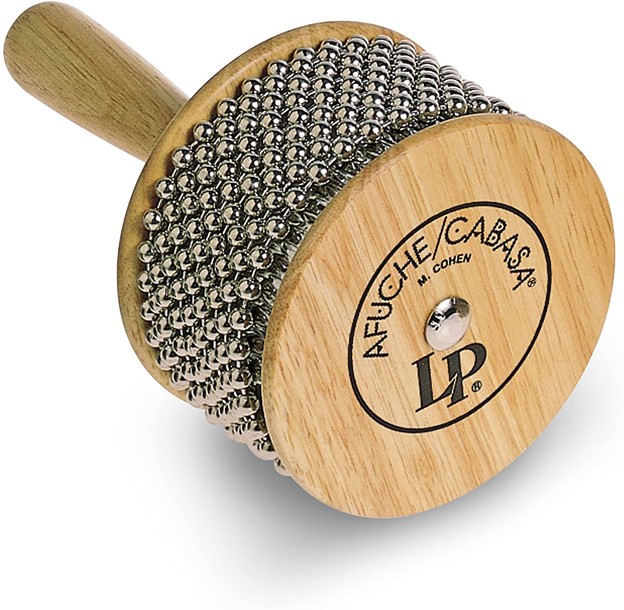
Have you ever heard the sound of a cabasa? You probably have, even if you didn’t know that’s what it was!
The cabasa, also known as an afuche, consists of a cylinder surrounded by beads that makes a rattling sound when shaken or twisted. Originating in Africa as the agbe, this instrument would have historically been constructed from a dried gourd with beads strung around the outer surface. The more modern metal cabasa that is often heard in Latin jazz like the bossa nova originated in the 1960s.
Click here to listen to the sound of the cabasa!
Music therapists often use the cabasa to address a variety of therapeutic goals. The novelty of the instrument and the unique tactile and auditory stimulation make this instrument conducive to practicing a range of skills. Below the music therapists at West Music share a some of the ways they like to use the cabasa in music therapy sessions.
Lucy uses the cabasa to increase range of motion or provide sensory stimulation. She places it in the client’s hand and turns it while singing Bob Marley’s “Three Little Birds.”
Noelle points out that though the cabasa is typically rolled in the hand, how about the rest of the body? Participants can choose to play it by having it rolled on their arm, shoulder, or knee providing tactile stimulation. A great song to sing with this is “Proud Mary” with the lyrics “rollin’, rollin’, rollin’ on the river.”
Rachael similarly uses the cabasa with adults with developmental disabilities who require extra support to participate. As she sings “Don’t Worry, Be Happy” she receives permission to play the cabasa on a participant’s arms or hands. When Rachael calls the line, “Don’t Worry” the cabasa becomes a microphone for the participant to respond with the line “Be Happy!”
Furthermore, Lorna uses the cabasa to practice identification of body parts by following directions to play all over! In addition, she leads a songwriting activity by replacing the word “Ravioli” with the participant’s favorite food. This encourages participants to communicate using visuals or verbally. Likewise, Hayley likes to encourage participants to join in the song “I Want Candy” by sharing their own favorite candy, and then playing the cabasa in between lines, as seen to the right.
“I want KIT KATS” (cabasa: ch ch ch ch-ch)
“I want REESE’S” (cabasa: ch ch ch ch-ch)
“I want M&Ms” (cabasa: ch ch ch ch-ch)
“I want SNICKERS” (cabasa: ch ch ch ch-ch)
Emma uses this instrument to provide sensory stimulation and to develop language skills. As she plays the song “Old Time Rock and Roll,” the participant is encouraged to roll the cabasa on their hand or leg and fill in the end of the phrase “I like that old time rock and ROLL.” Comparably, Rachel likes to use the song “The Twist” to facilitate motor skills. The participant is encouraged to complete each line of the song by playing independently on the word “Twist.”
Would you like to purchase a cabasa for you or a loved one? Click here to see what West Music has available!