Benefits of Music This Holiday Season
2020 has been a year of uncertainty and change in a plethora of ways. However, one thing that has remained true is the importance of remaining connected with our loved ones. While this has become more challenging due to physical distancing measures, it is simultaneously more important than ever before. People across the country and the world have found creative ways to stay in touch with the important people in their lives, using this time to build rich experiences and meaningful memories.
One prime way to build and maintain social connections is through music. Studies have shown that engaging in collaborative music-making can have positive effects on mental health, physical health, and overall happiness for people of all ages and ability levels. The following are some examples of the benefits of musical engagement!
Music can improve interactions between young children and their parents.
- Parental singing to newborn babies can lower infant stress and promote bonding between parent and child.
- Emotional interaction, mood stability, and parental stress may decrease when parents and their children take part in collaborative music therapy.
- Music therapy or music classes that involve parent-child dyads have been found to increase mutually responsive orientation, which means paying attention to the same thing at the same time.
- Suggestion: Take time to sing or make music with your child. You don’t have to be a trained musician to sing nursery rhymes or engage in musical play, and these 5-minute activities may become the memories that last a lifetime.
Learning an instrument and/or participating in a music ensemble provides many benefits for children, teens, and young adults.
- As part of an ensemble, students learn teamwork. They must rely on one another to perform their part well to make a harmonious whole. While meeting face-to-face has been challenging this year, many synchronous and asynchronous virtual options exist!
- Learning an instrument can provide students with a sense of autonomy and self-efficacy. In a time when we are not able to control much of what is happening around us, students can continuously strive towards mastery in music and take pride in their achievements.
- Engaging in active music-making can also be an excellent form of self-expression. Even when we might not have the words to convey our feelings, music can allow us to express ourselves. This can be seen in song choice, style of playing, improvisation, or songwriting, among other things.
- Suggestion: Talk to your child about what music or instruments they are interested in. Then, look for opportunities to purchase an instrument, sign them up for lessons, or enroll them in a class!
Music can have a positive effect on mood, even in the most difficult circumstances.
- Music has been found to improve mood and quality of life among cancer patients, those in inpatient psychiatric facilities, and those undergoing organ transplant.
- One study of women who have experienced intimate partner violence found decreased depression and anxiety following engagement with music.
- In times of heightened emotions, individuals can use the iso principle to regulate their mood. This involves finding music that matches your mood state (for example, slower music if you’re feeling sad, more aggressive music if you’re feeling angry, etc), then gradually transitioning the music to a more desirable mood state.
- Suggestion: Make a playlist of songs that make you happy, calm, or remind you of positive memories to help elevate your mood on difficult days.
Intergenerational music programs can foster relationships between people of all ages.
- Children benefit from these programs by receiving nurturing, love, and attention from older adults, as well as developing important social skills such as sharing, cooperating, and listening.
- Older adults benefit by gaining purpose, meaning, and a chance to feel connected to the larger society; studies have also shown improvements in older adults’ psychosocial, emotional, and physical well-being.
- Cross-age attitudes are improved by engaging in intergenerational programs, as younger people learn wisdom and perspective from the older generation; simultaneously, older individuals experience less isolation and more opportunities for cognitive and social stimulation.
- Suggestion: Interactions with older generations have become more complicated this year, but are likely not impossible! If technology allows, try connecting with loved ones over a video chat platform, and singing or listening to your favorite songs together. Other options include calling an older relative on the phone and singing a familiar song together, leaving a voicemail recording, or caroling outside a loved one’s window.
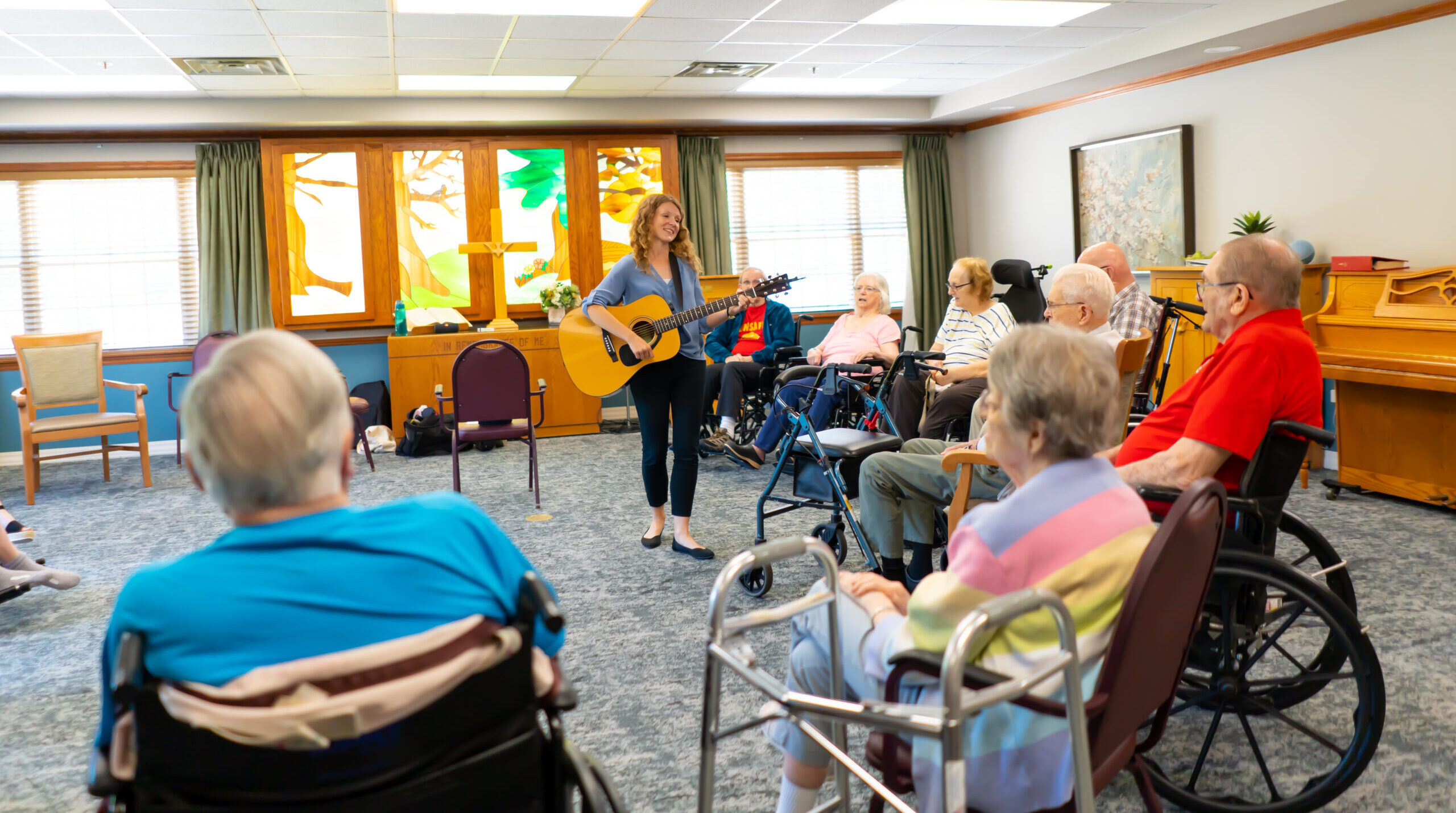
Active music-making has positive effects on the overall well-being of older adults.
- Among adults with dementia, music is often successful in decreasing depression, agitation, anxiety, and isolation. Additionally, singing or hearing familiar songs may bring back memories otherwise forgotten.
- A study of adults with Parkinson’s disease who were involved in a vocal skills choir found that participants reported a higher level of social connectedness and elevation in mood after engaging in the group.
- Health older adults may use music as a recreational activity that promotes social cohesion and provides cognitive stimulation. Additionally, pairing music with exercises may be beneficial to increase motivation and provide an enjoyable experience.
- Suggestion: Look for virtual opportunities for connection using music, whether it is an online stretching or exercise class, a Zoom choir, or even recorded music videos of favorite songs that can add joy to an elderly loved one’s day.
As we approach the holiday season and the conclusion of 2020, we encourage you to take some time to make music with your loved ones. Whether that is singing a silly song with your child or grandchild, connecting with friends through a virtual rock band, or learning the stories of your parents’ youth through their favorite songs, music can be a catalyst for unforgettable times.
Make music, make memories!