Music Therapy Services of West Music

Enriching lives through participation in music


Adaptive Music Teaching Strategies for Unique Learners

02/03/22

Part 1: The Individual

Remember: Every student is different, and students with special needs are no exception to this diversity. It is critical that we strive to understand our students’ preferences, strengths, and areas that will need additional support, no matter what level they’re at. There is no one “correct” way to do things.  Something might work for a while and then you’ll need to change course. This provides an opportunity to “think outside the box” and really challenge your teaching skills!

Focus on what your student CAN do rather than areas in which they struggle. Building on existing strengths can set them up for success!

Each challenge presents an opportunity, both to grow as an educator and to create a positive experience for your student.  It is important to focus on your students specific learning needs rather than becoming overly concerned with diagnoses or levels.  Observe what they’re doing and focus your attention on what they CAN do rather than what they struggle with. Building upon these strengths can help set them up for success. Every person is different in their learning styles.  Some students are visual learners and do better with seeing and imagining, others are auditory learners and prefer to listen and talk things through, still others are kinesthetic learners and learn best by doing.  And of course there are people who are a combination of styles!  Some of the tips we’ll share here may work like magic for some students, while others may not fit their needs.

Meet your students where they are in terms of learning style.

Some students may be visual learners, others are auditory learners, and still others may benefit from hands-on or kinesthetic learning. Build your toolbox to include multiple ways to present information in order to meet each student where they’re at.

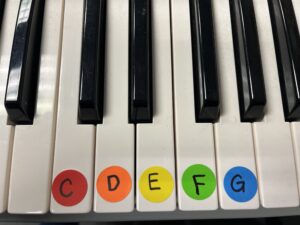
  • Consider color-coding your materials. For example, label keyboard keys with stickers so that each key corresponds to a color as well as a letter name.
  • Use vibrant shades and potentially textured stickers for students who are visually impaired. Colors that are more distinct from each other are easier to perceive; for example, light blue and bright red are more distinct than light blue and light green. Additionally, you can utilize different patterns, some bumpy and some smooth stickers, or even braille stickers to convey information to students through tactile means.
  • Represent information in a written form for students who benefit from seeing rhythms or notation on a page, but also represent information in an auditory form by playing the note or rhythm that the student is to play. Rhythmic patterns, for example, can often be difficult to understand at first when shown notation, but may become clearer when heard or paired with a common word or phrase. For example, quarter note-eighth note- eighth note becomes “strawberry”, four eighth notes become “watermelon”, etc.
  • Provide sensory interventions for students that may need to reach a more regulated state for learning. This could include something as simple as a fidget or toy for them to use to keep their hands busy when not playing. Some students may benefit from periodic breaks to engage in a sensory activity of their choosing. Learning can also be done through tactile means, such as stomping a rhythm or having the student tap it on their body.
  • Allow students to have input in how they learn materials. For example, if they are learning to read notes on the staff, they can work with their teacher to create their own pneumonic devices, pairing words and phrases they like and will remember with “EGBDF”, “GBDFA”, etc. While “Good boys do fine always” is a classic, “Good burritos don’t fall apart” can be a fun variation, and your students may have wonderful ideas of their own!
  • Repeat information often, as many students benefit from repetition. A slightly different wording or presentation on a different day may reach a student in a unique way and allow the information to click!

Meet your students where they are emotionally

If you’re sensitive to their anger, apathy, excitement, or whatever else they may be exhibiting, you may be able to move things in a productive direction more quickly. 

  • Consider matching the emotion they’re expressing. For example, if your student is angry, maybe start the lesson with an angry-sounding improvisation. Existing in this space and then transitioning gradually into a more desirable emotion for the task at hand can be a more gradual shift than simply giving a prompt or verbal redirection to change the student’s behavior.
  • Validate and simply state the emotion you’re seeing.  Calling it by name will acknowledge and possibly begin to diffuse it (your student will correct you if you’re wrong, so there’s not much harm in trying).  Be flexible and adjust your lesson plan in the moment.

Are you interested in more tips to support special learners in your life as they pursue musical education? 

The music therapy team at West Music has compiled a 4-part series with more tips!
The other posts will be shared periodically on this blog.

Don't want to wait for parts 2-4?

The entire series can be downloaded below! 

Categories

Archives

Join us in our mission of enriching lives through participation in music by donating to The West Family Foundation to help make music therapy services financially accessible to local individuals.


Sign up for our monthly newsletter to hear stories of the positive impact music therapy has on our communities, to learn more about music therapy, and to stay up-to-date on Music Therapy Services of West Music!